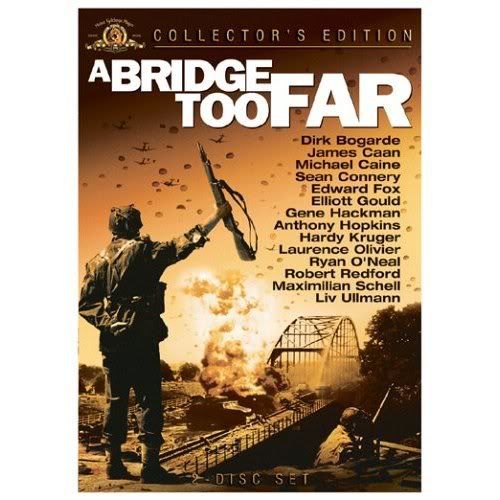
A fact-based retelling of Operation Market Garden, Richard Attenborough’s star-studded film suffers from its multiplicity of famous actors, and reminded this reviewer a little too much of Malick’s “Thin Red Line” (except Attenborough’s view of war does not match dead soldiers with injured birds). All in all, what was supposed to make this film a success instead ends up causing it to backfire, remaining a rather epic and mildly interesting re-enaction of the risky and dangerous WW2 operation.
Allied soldiers race to push through Operation Market Garden, which will cut off the Nazi movements into Holland; but as history has shown us, success was not to be, and the narrative presents viewpoints from various individuals at differing positions within the operation.
In terms of acting skill, reputation and calibre, it must be said that this film has the best of any ensemble piece. From Sean Connery to Robert Redford, Elliot Gould to Dirk Bogarde, and Laurence Olivier to Anthony Hopkins, this film is literally jam-packed with some of the best-known actors of recent times. However, whilst the actors do great jobs of portraying the men who were involved in this intricate military manouevre, they are simply too many in number to make individual impressions. Too many cooks is the most appropriate phrase. Michael Caine, Sean Connery and Anthony Hopkins are three of the army leaders who feature heavily here, all pressing to take the bridges of Holland in order to force the German offensive back. Dirk Bogarde, Laurence Olivier and Robert Redford appear in a smaller capacity, but each of them have important scenes, though Redford’s role appears a little tacked-on and cliched (an American soldier will try, against all odds, to save us foolish Brits?!). The sheer pedigree on display should light the film up, but Attenborough doesn’t get the best out of any, except perhaps Connery, who finally gets another role in which his Scottish brogue is not totally anachronistic. Some classic Brit and American actors shoehorn in cameos and supporting roles here, from Edward Fox to Elliot Gould and Ryan O’Neal. Famous actors in their own right, they don’t have much to work with and are, quite honestly, wasted here.
The one female character appears to be Liv Ullman’s Dutch housewife, and as this reviewer has absolutely no idea who she was or is, it seems appropriate to say that she really has to battle to make her role amount to something. Fortunately, she is given an opening narration, and also closes the film, and so her position as a woman amongst all these men gives the film its human aspects, as well as presenting the oft-forgotten fact that women suffer as much as men in war.
This is one of the better reconstructions of a WW2 scenario that I’ve seen, especially with it being made over twenty years ago. The action, locations and stunts are top-notch, and Attenborough reminds you constantly of why he is considered such a visionary director. Of particular note is the parachute drop of the soldiers sent in the first wave; quite how Attenborough managed to afford so many planes, extras and ambitious shots is beyond me, but it achieves the effect of throwing into what appears to be the real event. Richard Attenborough was well-known as an actor, but as a director his work does seem to attempt to transcend the medium (case in point: the marching scenes in Gandhi). This is film is no exception, with many scenes presenting the British director’s taste for realism. Within the realms of this particular movie, Attenborough’s attention to naturalism can be seen to be a result of his adaptation of the non-fiction book of the same name, and so the events and their depiction were always likely to be as spot-on as could be. And nevertheless, despite the actor issues, Attenborough presents his work as that of a director assured of his own vision, and as that of a man who seems determined to portray history as truly as possible.
The dialogue isn’t really something to pick up on; nevertheless, with the actors on display, and the plot based on real events, it can be said that most of what is said is fairly realistic. As you might expect from a war movie, the music is fairly bombastic but not so effective as to stick in the mind afterward. This area is where the film shines really. From blown bridges to tank attacks, and from paratroops landing in the thousands to man-to-man combat, the film features all forms of visual, and in all cases it is depicted realistically and vividly, in particular the bridge defence and attack at Arnhem.
The movie succeeds at what it doesn’t want to; being a perfect, dramatic historical re-enactment. In terms of an entertaining film, it fails, but Attenborough’s promise can be seen even here.
5/10


No comments:
Post a Comment